
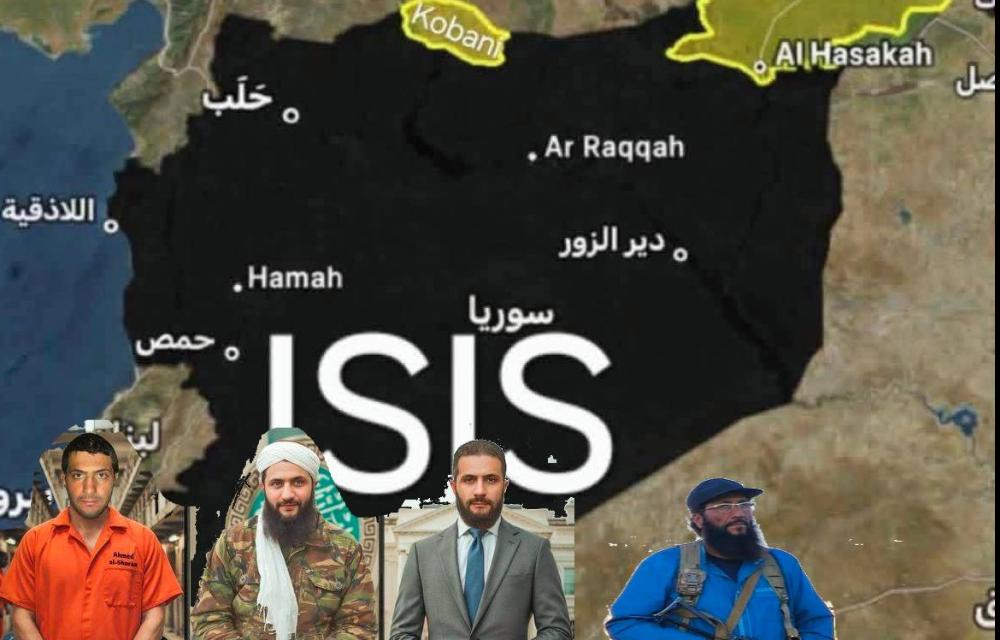
What is happening in Syria today cannot be described merely as a political transition or post-war stabilization. It is a systematic re-emergence of terrorism within state institutions, a highly organized scenario that extends beyond Syria and threatens regional and global security.
One of the clearest examples of this trend is Abu Ahmed, whose case dates back over 22 years. In the early 2000s, he was classified as a high-risk terrorist and a member of Jund al-Sham, involved in organized attacks targeting civilians and religious minorities, particularly Christians in Damascus. Due to his danger, he spent 21 years in Sednaya Prison and other high-security detention facilities.
The shocking reality today is that this past did not prevent him from reappearing in the new military structure in Syria, now in leadership positions under a government headed by individuals with their own known terrorist backgrounds.
At the forefront is Ahmad Al-Shar‘ (Abu Muhammad Al-Joulani), who was also a leader in extremist groups, previously imprisoned, and now appears as the political-military head of what is presented as a state. His rise to power confirms that this is not a coincidence or a mere political shift, but part of a carefully orchestrated plan.
The return of Abu Ahmed after 21 years in detention, alongside the rise of Al-Joulani, reveals a clear pattern: reintegration of former terrorist operatives into the structures of governance and the military, turning them from criminally accused militants into “official authorities.”
What is often called the “defeat of ISIS” was primarily a military defeat. The organization and its ideological network were not eradicated; rather, its operatives were repositioned within the state apparatus, with either direct or tacit support from the United States and its allies. What they could not achieve with weapons, they now gained without war: power and legitimacy.
This scenario could not succeed without clear regional support, especially from Turkey and Qatar, both repeatedly accused in the past of supporting extremist groups, including ISIS and al-Qaeda affiliates, through:
Logistics and supply routes
Financial and media support
Political cover
Today, these states continue to grant political legitimacy to a government structure that includes former terrorists.
Christians, Alawites, Druze, and other religious minorities in Syria face a direct existential threat. Past experiences with these groups have proven that their presence in power translates to killings, forced displacement, and the systematic destruction of religious and social diversity.
Movements of these forces near northeastern Syria indicate that Rojava represents the next focal point of this project, aiming to:
Undermine self-administration
Revive dormant ISIS cells
Open the door for renewed chaos that could extend beyond Syria
When former terrorists rise to state leadership,
and prisons become gateways to power,
we are no longer witnessing a normal political event, but a global, organized threat.
Terrorism that was defeated under black flags has now returned,
wearing a tie,
enclosed within a state,
and shielded by suspicious international silence.