
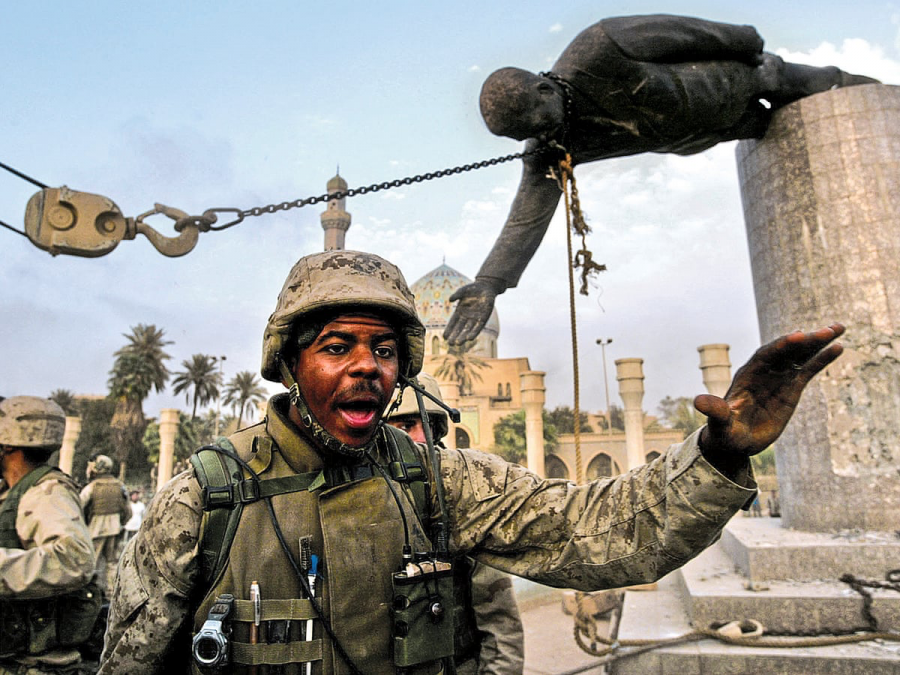
Twenty years have passed since the occupation of Iraq
The BBC revealed new details about the fall of Saddam Hussein's regime in Iraq.
Twenty years after the invasion of Iraq, the debate over the existence of "weapons of mass destruction" still provided the UK's justification for involvement, and new details about the search for weapons of mass destruction have emerged.
A few days before the anniversary of the Anglo-American invasion of Iraq, the BBC revealed that there were doubts within the government and British intelligence regarding information about Iraq's possession of weapons of mass destruction before the American invasion in 2003, and indicated that the issue of the presence of weapons of mass destruction in Iraq was a major issue in London's decision, but it was secondary to Washington's decision.
Luis Rueda, head of the CIA's Iraq Operations Group, said the issue of weapons of mass destruction was a secondary issue for Washington in a deeper campaign to overthrow Iraqi President Saddam Hussein. "We would have invaded Iraq even if Saddam had a rubber band and a paper clip, we would We will say he will goug out your eyes with them."
According to BBC documents, the supposed threat posed by Iraq's weapons of mass destruction, such as chemical, biological and nuclear weapons, was central to Britain.
Former British Prime Minister Tony Blair told the BBC: "The intelligence I was getting was what I was relying on, and I think I have the right to rely on it," stressing that he "tried until the last moment to avoid military action."
The documents stated that US President George W. Bush offered Blair, during a call, the opportunity to withdraw from participating in the beginning of the invasion, and to join the operation later, but Blair refused.
Blair defended his decision based on two reasons, namely the need to confront Saddam Hussein and maintain the relationship with the United States, and Blair said that the retreat could have had a significant impact on relations between London and Washington.
For his part, the former British Foreign Secretary, Jack Straw, said that he asked Richard Dearlove, then head of the British Intelligence Service "MI6", on three occasions about the source of the intelligence information about Iraq.
Straw expressed that he "had a feeling of uneasiness about this information, but Dearlove assured him on every occasion that these agents were reliable." However, Straw said it is ultimately up to the politicians to take responsibility, as they make the final decisions.
In turn, Dearlove refused to consider the "invasion of Iraq" an "intelligence failure", stressing that he still believed that Iraq had some kind of weapons program and that elements of those programs may have been transferred across the border to Syria.
On the other hand, David Omand, the security and intelligence coordinator in the British Cabinet during the period from 2002 to 2005, said that what happened "was a major failure," explaining that bias prompted government experts to listen to pieces of information that support the idea that Saddam Hussein had Weapons of mass destruction.
Some within the British intelligence service also revealed that they also had concerns about the Iraq file, and a former intelligence officer who worked in Iraq, who asked not to be identified, said that he "felt at the time that what they were doing was wrong."
Speaking of the period from early 2002, the former officer said that "there was no new or credible intelligence or assessment indicating that Iraq had resumed its weapons of mass destruction programs and that they posed an imminent threat."
He expressed his belief that the British government saw weapons of mass destruction as the only thing on which the legitimacy of military action could be suspended.